
Indoor air quality on vacation matters for the same reason it matters at home, only more so — research indicates people spend approximately 90% of their time indoors, and a trip doesn’t change that as much as you’d think. Inside is often the more polluted side of the door. The EPA states that the air within homes and other buildings can be more seriously polluted than outdoor air, with levels of several organic pollutants averaging two to five times higher indoors. Some pollutants are dramatically higher indoors. The EPA notes concentrations of many VOCs are consistently higher inside — up to ten times higher than outdoors. You arrive at the peak. A rental is cleaned fast, then closed up until check-in, which means whatever was used has had nowhere to go.
Indoor air quality on vacation is the variable nobody puts on a packing list. You research the beach, the drive, the restaurants, and the reviews. You do not research what you’ll be breathing for the next seven nights, in a house you’ve never been inside, while asleep for a third of the trip.
That’s not carelessness. It’s that nothing in the booking process gives you the information. Listings show countertops and sunsets. Air doesn’t photograph.
A vacation rental isn’t just somebody else’s house. Four things make it a distinct situation.
You have no baseline. At home, you know how you sleep and what your space smells like, so a change registers. In a rental, if you wake up on day two congested with a dull headache, you will blame the drive, the wine, the pillow, or the pollen. You will almost never suspect the room, because you have nothing to compare it to.
The cleaning happens right before you arrive. Turnovers are fast and often back-to-back. Products get used in volume, in closed rooms, sometimes within hours of check-in. The EPA lists cleansers, disinfectants, aerosol sprays, and air fresheners among common household sources of volatile organic compounds — and in a turnover, all four can appear in the same afternoon.
Then the house sits closed. Air conditioning on recirculate, windows shut, no one opening a door. Whatever was released has nowhere to go but into the fabric and the air you walk into. The EPA notes that inadequate ventilation increases indoor pollutant levels by not bringing in enough outdoor air to dilute emissions.
Everything is new to you. A new mattress, new furniture, carpet you didn’t choose, and an HVAC system you know nothing about. At home these are known quantities. Here, every one of them is an unknown you’re sleeping next to.
Not all of this is in every property, and none of it is cause for alarm. But this is the list worth knowing.
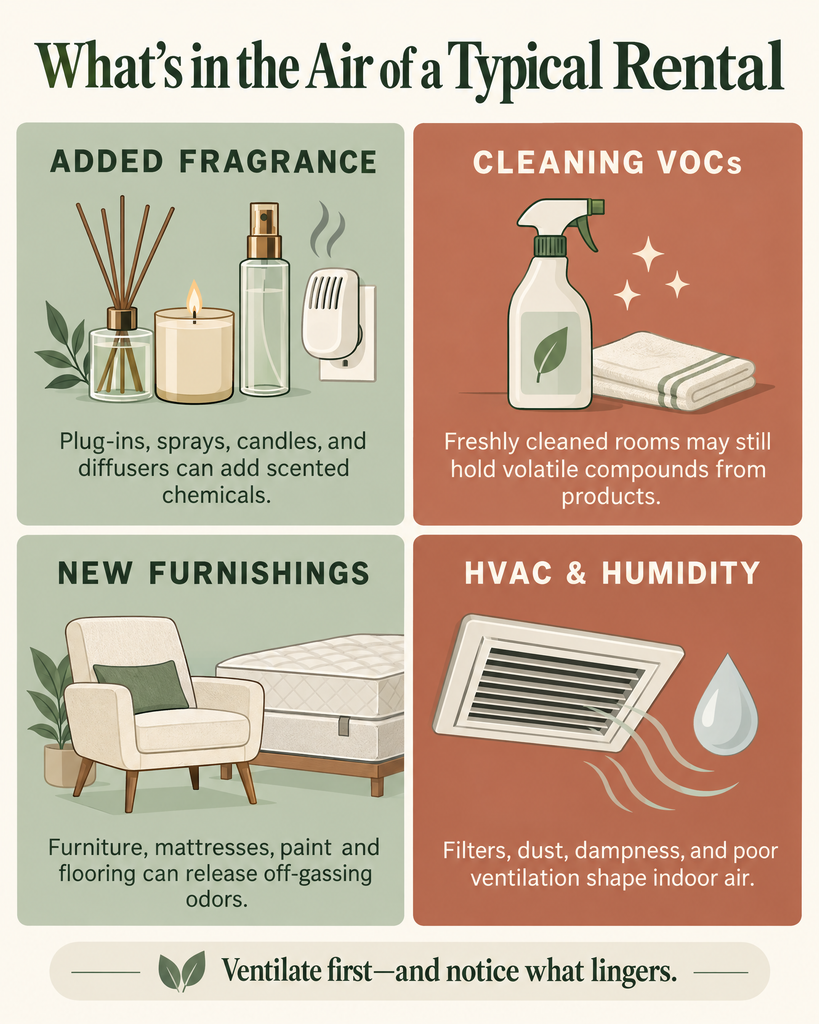
Added fragrance. Plug-ins, reed diffusers, automatic sprays, candles, and scented cleaning products. This is the most common and the most avoidable, and it’s the one that gets installed specifically because guests read scent as cleanliness.
VOCs from cleaning products. Covered above, and reapplied between every stay — which makes it the most repeated exposure in the house.
Formaldehyde from pressed wood. The EPA identifies pressed wood products — particleboard, hardwood plywood paneling, and medium density fiberboard made with urea-formaldehyde resins — as likely the most significant formaldehyde sources in homes. Rentals get furnished on a budget and refurnished often, which means more new pressed wood than an average house. The EPA notes homes with significant amounts of new pressed wood products can have levels above 0.3 ppm, and lists watery eyes, burning in the eyes and throat, nausea, and difficulty breathing at levels above 0.1 ppm.
Combustion products from gas appliances. The EPA notes that in homes with gas stoves, kerosene heaters, or unvented gas space heaters, indoor nitrogen dioxide levels often exceed outdoor levels — and that in homes without combustion appliances, the average is about half the outdoor level. NO2 acts mainly as an irritant to the eyes, nose, throat, and respiratory tract.
Humidity, in both directions. Too high and you get condensation and biological growth; the EPA recommends 30% to 50% relative humidity for homes. On the Gulf Coast the risk runs almost entirely in the high direction.
Whatever the HVAC is circulating. The EPA notes that contaminated central air handling systems can become breeding grounds for mold and mildew, distributing to every room they serve.
Dust, dander, and what guests track in. Carpet and upholstery hold what previous guests brought — pollen, sand, pet dander — and release it when disturbed.
“You can’t see the air, and the listing photos can’t show it. The only way to know is to ask the host.”
| Typical Vacation Rental | The Rooted Escape | |
| Scent | Added, to signal clean | Nothing added |
| Cleaning | Whatever’s fast, usually scented | Non-toxic, fragrance-free, every turnover |
| Air handling | HVAC filter only | Air purifiers placed throughout the home |
| Bedding | Conventional, unspecified | Organic mattresses and bedding |
| Pest control | Routine chemical spraying | No pesticides used |
| Ventilation before arrival | House closed until check-in | A priority, not an afterthought |
These work whether you booked with us or not.
1. Air the place out the moment you walk in. Open doors and windows on opposite sides of the house for twenty minutes. Cross-ventilation does more for indoor air in those twenty minutes than anything else you can do all week, and it costs nothing.
2. Unplug the air fresheners. Walk the house and pull every plug-in, remove reed diffusers to a closed cabinet, and set candles aside. This is the fastest meaningful improvement available to you.
3. Switch the HVAC fan to circulate, then check the filter. If the filter is visibly loaded and you can find a replacement, changing it is a reasonable ask of a host. At minimum, know what you’re dealing with.
4. Run bathroom and kitchen exhaust fans more than feels necessary. Every shower and every meal adds moisture. On a humid coast, the fan is doing real work.
5. Bring your own pillowcase. Eight hours a night, directly against your face, is the single highest-exposure contact in the house. One pillowcase in your bag removes that unknown entirely.
6. Give wet swimsuits and towels somewhere outside to dry. A pile of damp beach gear in a closed bathroom raises humidity in the rooms you sleep in.
7. Trust your nose, in both directions. A musty smell means moisture somewhere. A strong floral smell means something was added. A house that smells like nothing is the goal, not a sign that nobody cleaned.
Ask what the home is cleaned with, and whether anything scented is used anywhere.
Ask whether there are plug-ins, diffusers, or automatic sprays, and whether they can be removed before arrival.
Ask whether air purifiers are provided and in which rooms.
Ask how humidity is managed between stays — on the Gulf Coast this is the most revealing question of the set.
Ask when the house was last refurnished, if anyone in your group is sensitive to new furniture off-gassing.
Ask whether the kitchen range is gas or electric, and whether the hood vents outside.
It often is. The EPA states indoor air can be more seriously polluted than outdoor air, with several organic pollutants averaging two to five times higher indoors and many VOCs up to ten times higher.
I feel worse on vacation than at home. Could it be the rental? It’s worth considering, particularly if symptoms are respiratory or start within a day of arrival and ease when you’re outside. Travel, sleep disruption, alcohol, and different pollen all contribute too — but the room is a variable most people never think to test.
Does opening a window actually help? Yes, and more than most people expect. Ventilation dilutes indoor pollutants with outdoor air, and the EPA identifies inadequate ventilation as a direct cause of elevated indoor levels. On a humid coast, air out in short bursts rather than leaving windows open all day, so you’re not adding moisture.
Should I bring a portable air purifier? If you or someone in your group has asthma or significant sensitivity, a small unit for the bedroom is a reasonable thing to pack. For most travelers, picking a property that already runs them is the easier route.
What’s the single highest-value thing I can do for indoor air quality on vacation? Unplug the air fresheners and open the windows for twenty minutes on arrival. Two minutes of effort, and it addresses the two biggest variables you can actually control.
Indoor air quality on vacation isn’t about anxiety over invisible chemicals. It’s about recognizing that you’re going to spend most of your trip inside a building you know nothing about, and that a few questions before booking tell you most of what you need to know.
The good news is that the fixes are cheap and the questions are easy. The better news is that some hosts have already answered them.
“You picked the view. It’s worth a thought for the air that comes with it.”
Whether this is your first stay with us or your fifth, you’re welcome to ask any of the questions above before you book.
Want to Know What You’ll Be Breathing on Your Next Trip? We’d love to host you.
Click this link to check availability and book direct.
Related: What to Look for in a Non-Toxic Vacation Rental | How Air Purifiers Work | Fragrance-Free vs. Unscented
Fragrance-Free vs. Unscented: What the Label Really Means says:
[…] What to Look for in a Non-Toxic Vacation Rental | Indoor Air Quality on Vacation | Mold Prevention in Humid Coastal […]
Better Sleep on Vacation: The Room, Not the Routine says:
[…] Related: Indoor Air Quality on Vacation | How Air Purifiers Work | What to Look for in a Non-Toxic Vacation Rental […]