
Where Wellness Meets Vacation
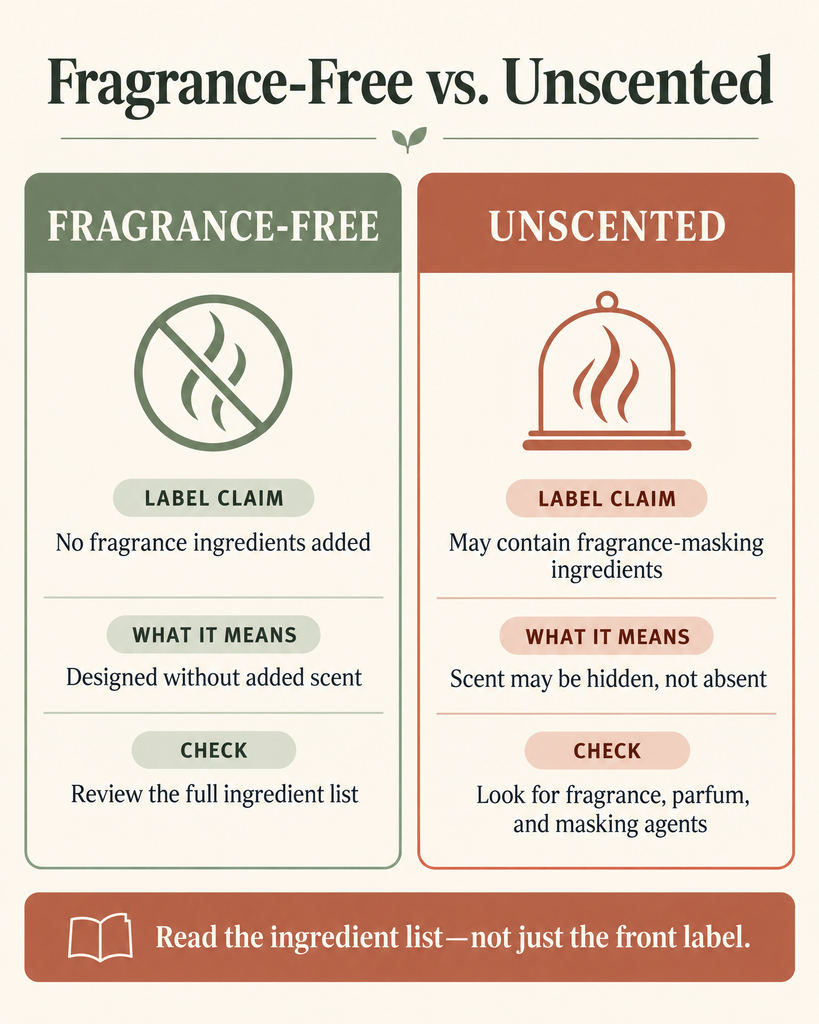
Fragrance-free vs. unscented is not a marketing distinction — it’s a formulation one. Unscented describes how a product smells. Fragrance-free describes what’s in it. The FDA says it directly: “Even some products labeled ‘unscented’ may contain fragrance ingredients.” They’re added to mask the smell of other ingredients, not to make the product smell like anything. One word on a label can hide dozens of ingredients. The FDA permits fragrance ingredients to be listed simply as “Fragrance,” because the formulas are treated as trade secrets. This affects more people than most hosts realize. In a national US survey, 34.7% of Americans reported adverse health effects from fragranced consumer products.
Fragrance-free vs. unscented is the single most useful distinction in non-toxic living, and almost nobody gets told about it. You do the responsible thing, read the front of the bottle, see “unscented,” and assume you’ve solved the problem.
You may not have. And if you’re someone who gets a headache from hotel sheets or feels your chest tighten in a freshly cleaned bathroom, this is the detail that explains why a product you carefully selected still caused a reaction.
Here’s the difference, and why we built an entire house around the second term.
The two terms describe different things, which is exactly why they get confused.
Unscented is a sensory claim. It means the finished product doesn’t have a noticeable smell. It says nothing about whether fragrance chemicals were used to get there.
Fragrance-free is a formulation claim. It means no fragrance materials were added at all.
The gap between them is where people get caught. Raw ingredients in cleaners, detergents, and personal care products often smell — of petroleum, of surfactants, of whatever the active compound is. One way to deal with that is to reformulate. The cheaper way is to add a masking fragrance that cancels the odor without leaving a perceptible scent of its own. The result smells like nothing, and is accurately labeled “unscented.”
The FDA addresses this on its own fragrances page, noting that a manufacturer may add enough fragrance to mask the odor of other ingredients without the product becoming noticeably scented. Its advice is to choose products that are fragrance-free and check the ingredient list carefully.
Neither term is regulated with a legal definition, which is why reading the ingredient list matters more than reading the front of the bottle.
This is the part that surprises people most.
On a US ingredient list, most components must be named individually. Fragrance is the exception. The FDA states that fragrance and flavor ingredients “can be listed simply as ‘Fragrance’ or ‘Flavor'” — because fragrance formulas are complex mixtures of natural and synthetic chemicals, and they’re likely to be trade secrets under the Fair Packaging and Labeling Act.
So a single word on a label can represent a large number of undisclosed ingredients. Not because anyone is hiding something sinister, but because the regulation was written to protect formulations rather than to inform consumers.
The practical consequence: if you react to fragranced products, you generally cannot identify which specific compound is responsible by reading labels. You can only avoid the category. That’s not an oversight on your part — the information isn’t there to find.
Where to look on a label:
The ingredient list, not the front of the package
The words “fragrance,” “parfum,” or “aroma,” which all signal an undisclosed mixture
“Essential oil” or a named botanical extract, which is still an added scent
The phrase “masking fragrance,” used by some manufacturers
Products with no fragrance term anywhere in the ingredient list, which is the actual goal
It’s easy to file fragrance under preference. The survey data suggests otherwise.
In a nationally representative US survey published in Air Quality, Atmosphere & Health, 34.7% of Americans reported one or more adverse health effects from exposure to fragranced consumer products. Broken out: 18.6% reported respiratory problems, 16.2% mucosal symptoms such as watery eyes or nasal congestion, 15.7% migraine headaches, 10.6% skin problems, and 8.0% asthma attacks. More than 15% of respondents reported having lost workdays or a job because of fragranced product exposure.
For people with asthma specifically, a follow-up study found that 33.9% reported adverse effects from air fresheners or deodorizers.
And relevant to anyone in hospitality: the same research found that more than twice as many customers would choose a hotel or an airplane with fragrance-free air over one with fragranced air.
“Unscented tells you what a product smells like. Fragrance-free tells you what’s in it. Only one of those is a formulation.”
| Unscented | Fragrance-Free | |
| What it claims | No noticeable smell | No fragrance added |
| Fragrance in the formula? | Possibly, as a masking agent | No |
| Regulated definition | None | None |
| How to verify | You can’t, from the front label | Check the ingredient list for fragrance, parfum, or aroma |
| Safe for fragrance-sensitive guests | Not reliably | Yes, when the ingredient list confirms it |
1. Ignore the front of the package entirely. Every meaningful claim is on the back. Treat the front as advertising, because that’s what it is.
2. Scan for four words. Fragrance, parfum, aroma, and essential oil. If none appear, you’re likely holding a genuinely fragrance-free product.
3. Don’t assume natural means fragrance-free. An essential oil is an added scent, and it’s a volatile compound by definition — that’s what makes it smell. Plenty of people who react to synthetic fragrance also react to essential oils. “Natural fragrance” is still fragrance.
4. Check the laundry products first. Detergent, fabric softener, and dryer sheets leave residue on fabric that sits against skin and near airways for hours. If you change one category, change this one.
5. Watch out for “free from” lists that skip fragrance. A label touting no parabens, dyes, or sulfates may still contain fragrance. Specific absences are not general ones.
6. Remember that scent is the easiest thing to add back. A home cleaned with fragrance-free products and then finished with a plug-in or a candle is not a fragrance-free home. The last step counts as much as the first.
Ask whether the host uses fragrance-free products or unscented ones, and listen for whether they know the difference.
Ask what the laundry is washed in, since bedding and towels carry residue directly to skin.
Ask whether there are plug-ins, reed diffusers, automatic sprays, or candles anywhere in the home, and whether they can be removed before arrival.
Ask whether essential oil diffusers are used, which many hosts consider a fragrance-free choice and which fragrance-sensitive guests often do not.
Ask whether the home is treated with scented pest control or carpet products.
No. Unscented means no noticeable smell, and the FDA notes that unscented products may still contain fragrance ingredients used as masking agents. Fragrance-free means no fragrance was added.
Why can’t I find out what’s in “fragrance”? Because the FDA allows fragrance to be listed as a single term, since fragrance formulas are treated as trade secrets under the Fair Packaging and Labeling Act. The individual components are not required to appear on the label.
Are essential oils a safe alternative? They’re a different alternative, not automatically a safer one. Essential oils are volatile compounds and they are an added fragrance. Many fragrance-sensitive people react to them, so a home using diffusers isn’t fragrance-free.
Does fragrance-free mean the home isn’t clean? It means the opposite of what the scent industry trained us to expect. Cleaning and disinfection don’t require fragrance, and the fragrance was never doing the cleaning — it was signaling it.
I don’t think I’m sensitive to fragrance. Does this matter to me? Possibly not consciously. But the survey figures suggest a third of people experience some effect, and plenty of them have never connected a headache or a stuffy nose to the room they were in. The way most guests notice is that they sleep better and don’t know why.
Fragrance-free vs. unscented is a four-second check on the back of a bottle that changes what you’re actually bringing into your home — or walking into on vacation.
We chose the harder term on purpose. Nothing is added to this house to make it smell like anything, which means what you smell when you walk in is just a clean house and whatever the Gulf breeze brought with it.
“A home that smells like nothing isn’t missing something. That’s the finished product.”
Whether this is your first stay with us or your fifth, we’re glad to tell you exactly what’s used in the house and what isn’t.
Want a Stay Where Nothing Is Added to the Air? We’d love to host you.
Click this link to check availability and book direct.
Related: What to Look for in a Non-Toxic Vacation Rental | Indoor Air Quality on Vacation | Mold Prevention in Humid Coastal Homes
Indoor Air Quality on Vacation: What You're Breathing says:
[…] Related: What to Look for in a Non-Toxic Vacation Rental | How Air Purifiers Work | Fragrance-Free vs. Unscented […]