
A non-toxic vacation rental is one where the materials, cleaning products, and air were decided on deliberately — not a listing that uses the words “eco” or “green” as decoration. It matters because of where you actually spend a vacation. Research indicates people spend roughly 90% of their time indoors, and a beach trip is no exception once you count sleeping, cooking, and rainy afternoons. Indoor air is frequently the most polluted air. The EPA states that the air inside homes and other buildings can be more seriously polluted than outdoor air, with levels of several organic pollutants averaging two to five times higher indoors. The bedroom is the highest-exposure room in any rental — eight hours a night, in one closed space, breathing whatever the mattress, bedding, and last clean left behind.
Knowing what to look for in a non-toxic vacation rental starts with a moment most travelers recognize. You book a week away to feel better than you do at home. Then you arrive, open the door, and walk into a wall of air freshener.
It’s such a normal part of travel that most people stop noticing it. The sharp floral hit in the entryway. The bleach smell in the bathroom. The plug-in behind the couch. We’ve been trained to read those smells as proof that a place is clean — when what they actually tell you is that something was sprayed in a closed room shortly before you walked in.
A non-toxic vacation rental is built on the opposite idea: that a clean home shouldn’t smell like anything at all.
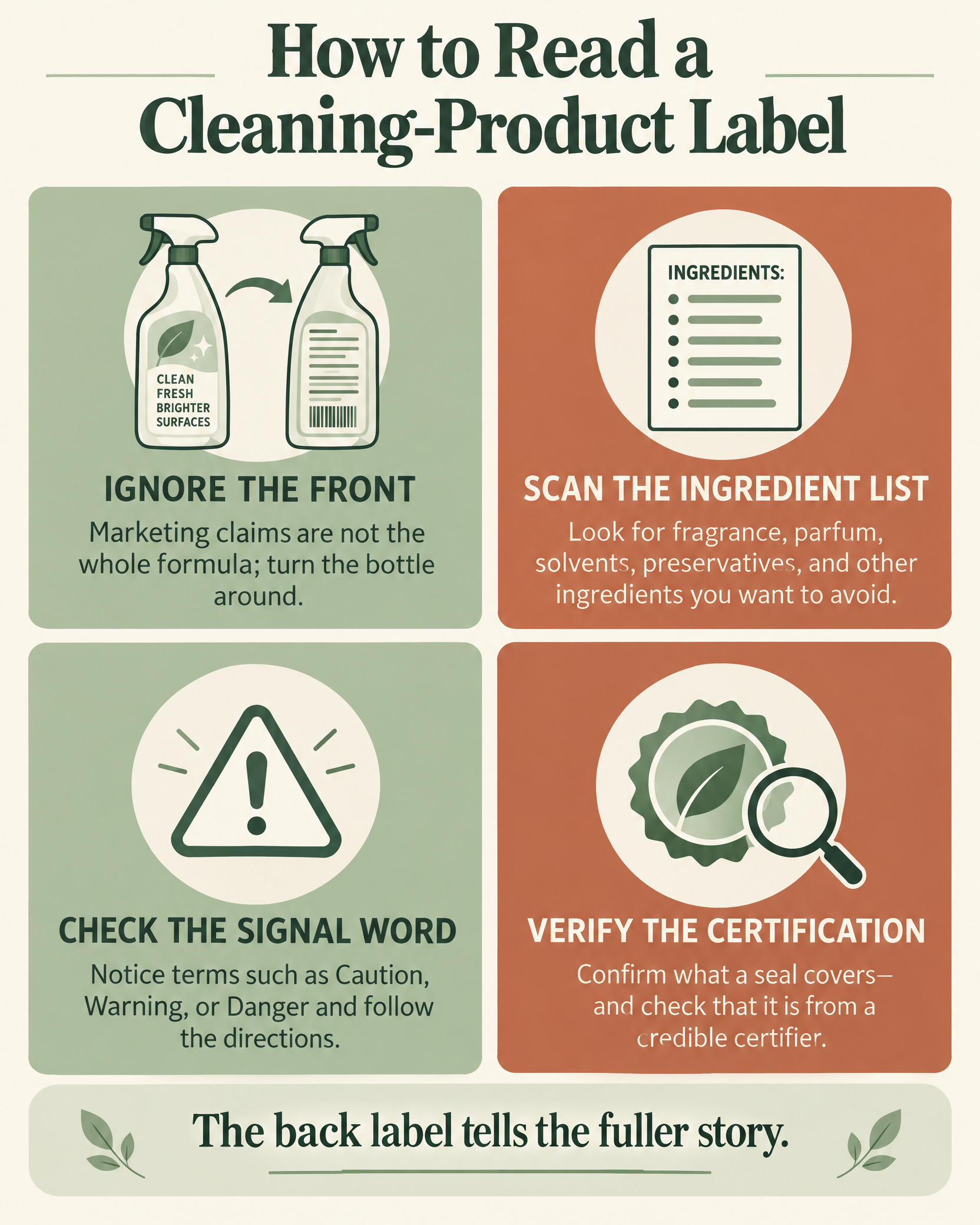
The phrase gets used loosely, so it’s worth being specific. “Non-toxic” isn’t a regulated term, and no agency certifies a rental as one. That means the only thing that distinguishes a genuine non-toxic vacation rental from a listing with nice adjectives is whether the host can tell you exactly what they did. Everything on this list starts with the same skill — knowing how to read a cleaning product label.
Here’s what the decision list looks like in practice.
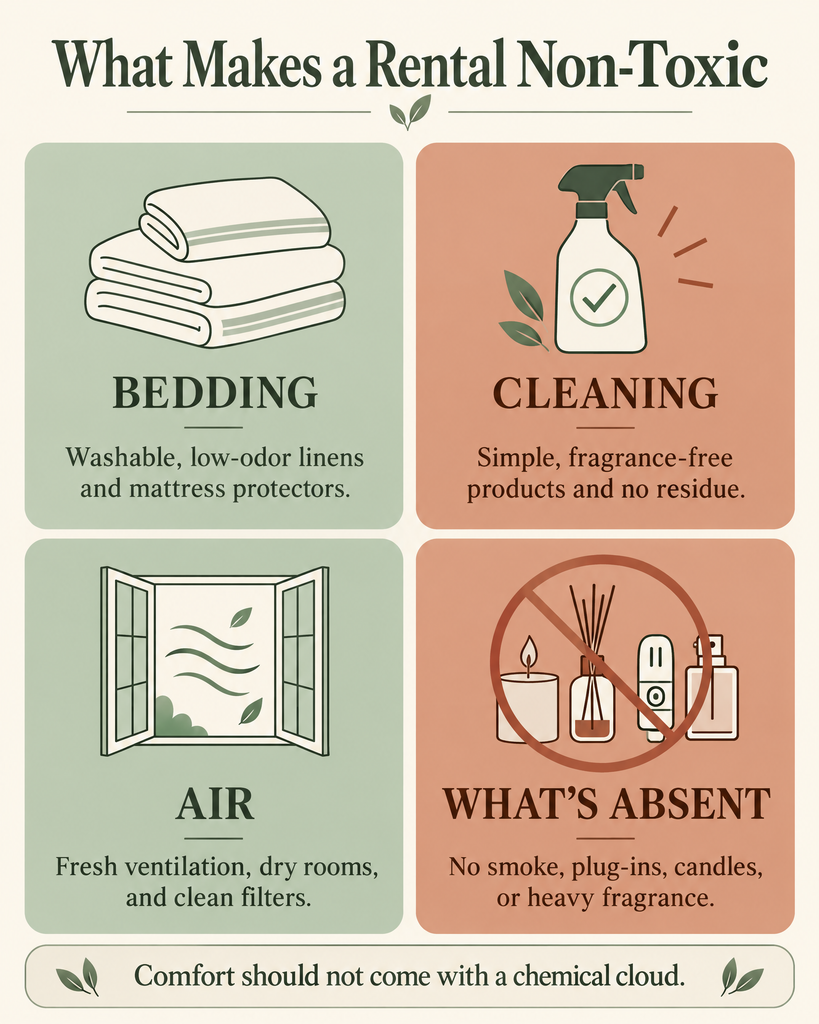
The bedding and mattresses. A conventional mattress is a large piece of manufactured foam and textile sitting a few inches from your face for eight hours, warming under your body heat. Organic mattresses and bedding remove a source most people never think to ask about — and the bedroom is where exposure time is longest.
The cleaning products. This is the single biggest lever, because it’s the one thing that gets reapplied between every single stay. Conventional cleaners and aerosol sprays are a well-documented source of indoor volatile organic compounds, and the EPA lists cleansers, disinfectants, aerosol sprays, and air fresheners among the common household sources of VOCs in the home.
The air itself. Air purifiers throughout a home address the particulates that accumulate in any house — dust, dander, pollen tracked in from outside, and whatever the last guest’s beach bag brought with it.
What’s deliberately absent. No artificial fragrance. No aerosols. No pesticides. These are absences, which makes them easy to overlook on a listing and impossible to miss once you’re breathing the result.
The things nobody photographs. Ventilation, humidity control, and what happens to the house between bookings. A coastal property that sits closed up and warm for two weeks is a different environment than one that’s actively managed, and neither shows up in the photos.
You might reasonably wonder why any of this matters more on a seven-day trip than it does at home. Three reasons.
You have no baseline. At home, you know what your space smells like and how you sleep in it. In a rental, if you wake up congested on day two with a headache, you’ll blame the drive, the wine, the pillow, the pollen. You will almost never blame the room — because you have nothing to compare it to.
Exposure is concentrated and continuous. Vacation rentals are cleaned hard and fast between back-to-back bookings, often with scented products, in a house that’s then closed up until check-in. You arrive at the peak of that concentration.
You’re there to recover. Most people book a trip to sleep, breathe, and reset. A week of poor air quality works directly against the thing you paid for — and the people most affected are exactly the ones who need the rest most: children, anyone with asthma, anyone with migraine, and anyone sensitive to fragrance.
“A clean home shouldn’t smell like anything. If it smells like a meadow, something was added — not removed.”
| Typical Vacation Rental | The Rooted Escape | |
| Cleaning | Whatever’s fastest, usually scented | Non-toxic, fragrance-free, every turnover |
| Scent | Fragrance added to signal “clean” | Nothing added — the goal is neutral |
| Bedding | Conventional mattresses, unknown linens | Organic mattresses and bedding |
| Air | Whatever the HVAC filter catches | Air purifiers placed throughout the home |
| Pest control | Routine chemical spraying | No pesticides used |
| How you find out | You don’t, until you’re there | Stated up front, in detail |
1. Specifics instead of adjectives. “Eco-friendly” and “wellness retreat” are free to write. “We clean with fragrance-free products and run air purifiers in every bedroom” costs something to be true. Look for the second kind.
2. Check the photos for what’s in them. Plug-in air fresheners, reed diffusers, candle clusters, and bowls of potpourri all tell you the host’s approach to scent. So does a styled shot of cleaning products under the sink.
3. Read the reviews for the words hosts don’t write. “Musty,” “stuffy,” “strong smell,” and “my allergies” are the terms worth searching for. So is “I slept so well” — which guests mention far more often in homes where the air is handled well.
4. Ask one direct question. Message the host and ask what they clean with. A host who’s made real decisions will answer in a sentence. A host who hasn’t will answer vaguely, or not at all. Either way you learn what you need to know.
5. Ask about the gap between bookings. On the Gulf Coast especially, what happens to a house while it’s empty matters as much as what happens before you arrive. Is the AC left running? Is humidity controlled? A host who has thought about this will say so immediately.
6. Bring your own anyway, the first time. Your own pillowcase takes no space and removes the biggest unknown from the room you’ll spend the most hours in. Once you’ve stayed somewhere that handles this properly, you’ll stop needing to.
Ask what products are used for cleaning, and whether anything scented is used anywhere in the home.
Ask whether there are plug-ins, diffusers, or automatic sprays, and whether they can be removed before you arrive.
Ask what the mattresses and bedding are made of, particularly if anyone in your group has eczema, asthma, or fragrance sensitivity.
Ask whether air purifiers are provided, and in which rooms.
Ask how humidity is managed between stays — the most revealing question of the set in a coastal property.
Ask whether pesticides are used indoors or around the entrances.
No. There’s no regulatory definition and no agency that certifies a rental. That’s exactly why the specifics matter more than the label — ask what was actually done, and judge the answer.
Isn’t fragrance-free the same as unscented? No, and this trips up a lot of careful shoppers. The FDA notes that even products labeled “unscented” may contain fragrance ingredients, added to mask the smell of other ingredients. Fragrance-free is the term to look for.
It doesn’t. Effective cleaning and disinfection don’t require added fragrance, and fragrance was never what was doing the work. The scent is a marketing layer on top of the cleaning, not part of it.
The test of whether a host made them is simple: ask, and see how specie cleaning, not part of it.
Once you’ve found the right house, the island does the rest — these are the things to do in Perdido Key worth building a week around.
Who notices the difference most? People with asthma, migraine, eczema, or chemical sensitivity usually notice within hours. Families with infants and young children notice over a few days. Most other guests notice it as better sleep without being able to say why.
Is this just a more expensive version of the same thing? The costs are real — organic mattresses and genuine non-toxic cleaning products cost more than the alternatives. Whether that’s worth it depends on how you sleep and who you’re traveling with. For a lot of our guests, it’s the reason they stopped staying in hotels.
A non-toxic vacation rental isn’t a luxury category or a wellness aesthetic. It’s a set of unglamorous decisions — about what’s on the bed, what’s in the cleaning cupboard, and what’s running in the bedrooms — made before you ever see the listing.
The test of whether a host made them is simple: ask, and see how specific the answer is.
“You booked the trip to breathe easier. The air should be part of what you’re paying for.”
Whether this is your first stay with us or your fifth, we’re happy to answer any of the questions above in detail before you book.
The single most useful label check on that list has a name, and it’s worth four seconds at the shelf: Choosing the right cleaning products is also important when creating a healthier home. Learn the difference between fragrance-free and unscented products so you know what ingredients to look for when selecting household products.
Looking for a Place to Stay Where the Air Isn’t an Afterthought? We’d love to host you.
Click this link to check availability and book directly.
Related: Fragrance-Free vs. Unscented | Indoor Air Quality on Vacation | Mold Prevention in Humid Coastal Homes

Better Sleep on Vacation: The Room, Not the Routine says:
[…] Related: Indoor Air Quality on Vacation | How Air Purifiers Work | What to Look for in a Non-Toxic Vacation Rental […]