
How air purifiers work is simpler than the marketing suggests: a fan pulls room air through a filter, particles get trapped in the filter media, and cleaner air comes out the other side. Everything else is a detail about which filter and how fast. The number that matters is CADR — Clean Air Delivery Rate. The EPA is clear that higher CADR means more particles removed and a larger area served, and equally clear that “The CADR rating system is for particles only.” Particles and gases are two different jobs. A HEPA filter handles particles. Gases and odors need activated carbon, and the EPA notes carbon filters can be effective “provided that there is a large amount of material used in the filter.” A purifier is not a substitute for fixing the problem. In the EPA’s words: “Filtration does not replace the need to control pollutants and ventilate.”
How air purifiers work is worth understanding before you buy one, because the category is full of devices that look identical, cost wildly different amounts, and do measurably different things. Some of them don’t work. A few make the air worse.
We run purifiers throughout our home, so we’ve had reason to learn the difference. Here’s the plain version.
A portable air purifier is a fan and a filter in a box.
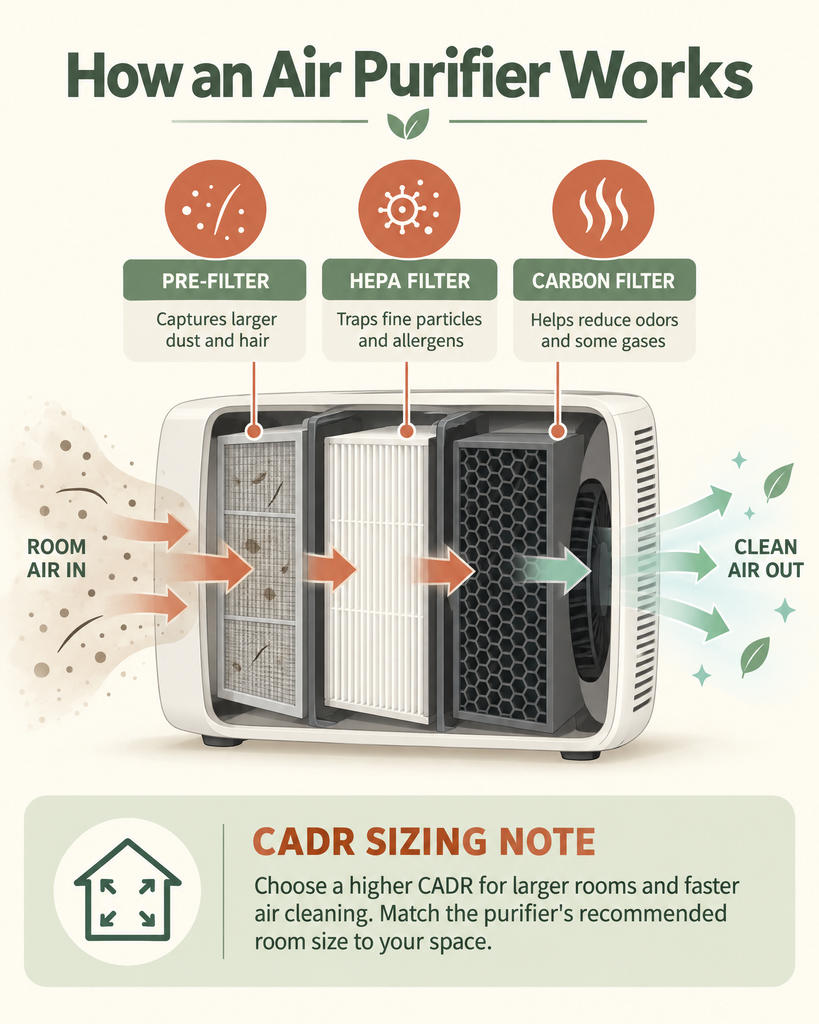
The fan draws room air in. The air passes through filter media — usually a pleated, densely packed mat of fine fibers. Particles in the air collide with those fibers and stick, through a handful of physical mechanisms that all amount to the same practical outcome: the particle stops, the air keeps going. Filtered air exits, and the process repeats.
That’s it. The sophistication lives in two places: how efficiently the filter captures particles, and how much air the fan can move through it per minute. Those two things trade off against each other — a denser filter captures more but resists airflow more — and a well-designed unit balances them.
Which means the two questions worth asking about any purifier are: what does the filter catch, and how much air does it actually move?
The particle filter. The EPA notes that a high-efficiency particulate air (HEPA) filter is a common way portable units achieve a high CADR. This is the component that handles dust, pollen, dander, smoke particles, and mold spores — anything with physical mass suspended in the air.
The activated carbon or sorbent filter. A separate stage, and the only part that addresses gases and odors. Carbon works by adsorption rather than straining: gas molecules bind to the enormous internal surface area of the carbon. The EPA’s guidance is specific about the catch — carbon filters can be effective provided there’s a large amount of material in the filter. A thin carbon-coated mesh is not the same product as a substantial carbon bed, even though both get described as “carbon filtration” on the box.
The fan. Determines how much air gets treated per minute, which determines how large a room the unit can actually serve.
The pre-filter. A coarse screen that catches hair and large dust so the expensive filter lasts longer. Usually washable.
CADR is the number that lets you compare two units honestly, because it measures delivered performance rather than filter capability in isolation.
The EPA’s sizing method is refreshingly simple: multiply the room’s length by its width to get square feet, then compare that figure to the maximum room size listed on the packaging. Its reference points for particle CADR, based on eight-foot ceilings, run from a minimum of 65 cfm for a 100-square-foot room up to 390 cfm for 600 square feet. Higher ceilings need a higher CADR.
Two caveats that matter.
CADR covers particles only. The EPA states this directly. There is no equivalent consumer rating for gas and odor removal — the agency notes the lack of widely used performance ratings for gas removal — so a high CADR tells you nothing about how well a unit handles VOCs or smells.
Undersized is the most common mistake. A unit rated for 150 square feet in a 400-square-foot living room will run constantly and accomplish little. Buying for the room you actually have beats buying the unit with the best reviews.
“A purifier filters the air in a room. It doesn’t remove what’s putting things into the air in the first place.”
| What a Purifier Handles | What It Doesn’t | |
| Particles | Dust, pollen, dander, smoke, mold spores in the air | Mold growing on a damp surface |
| Gases | Some VOCs and odors, with enough activated carbon | Gases, without a substantial carbon stage |
| Moisture | Nothing | Humidity — that’s a dehumidifier’s job |
| Sources | Nothing | The plug-in, the leak, the gas range |
| Ventilation | Nothing | Fresh air exchange — open a window |
1. Size it to the room, using the square footage. Length times width, then match it to the room size on the box. This single step eliminates most disappointment with air purifiers.
2. Prioritize bedrooms. You spend more consecutive hours in a bedroom than any other room, and you spend them breathing deeply at a fixed location. If you’re only running one unit, run it where you sleep.
3. Insist on real activated carbon if odors or VOCs are the concern. Ask about the weight of carbon, not just whether carbon is mentioned. A thin coated pad will not do the job the EPA describes.
4. Change filters on the manufacturer’s schedule. A loaded filter reduces airflow, which reduces delivered clean air. Carbon is worse — it saturates and stops adsorbing, and a saturated carbon filter can begin releasing what it captured.
5. Don’t block the intake or the outlet. Behind a curtain, against a wall, or under a nightstand all cut performance. Give it clearance on the sides it breathes from.
6. Run it continuously on a lower speed rather than intermittently on high. Steady air changes beat bursts, and it’s quieter — which is the real reason people turn purifiers off and leave them off.
7. Avoid anything that intentionally produces ozone. The EPA’s guidance is to avoid devices that intentionally produce ozone because ozone is a lung irritant, and it notes that no federal government agency has approved these devices for use in occupied spaces. Its dedicated page on ozone generators is blunter still: ozone is generally ineffective at controlling indoor air pollution at concentrations that stay within public health standards, inhaled ozone can damage the lungs, and relatively low amounts can cause chest pain, coughing, shortness of breath, and throat irritation. On odors specifically, the EPA notes that body odor may be masked by the smell of ozone without being removed.
This is the part the industry doesn’t advertise. The EPA’s own framing is that filtration is a supplement: “Filtration does not replace the need to control pollutants and ventilate.”
In practice, that means three things in order.
Source control first. Remove the plug-in, switch to fragrance-free cleaning products, fix the leak, vent the range outside. Nothing you buy outperforms not adding the pollutant.
Ventilation second. Outdoor air dilutes indoor pollutants, and no filter substitutes for that exchange. On a humid coast, air out in short bursts rather than leaving windows open for hours.
Filtration third. Now a purifier is working on what’s left rather than fighting a running faucet.
For airborne particles, yes — that mechanism is well established, and CADR gives you a comparable measure of how much clean air a unit delivers. For gases and odors, it depends entirely on whether there’s a meaningful amount of activated carbon, and there’s no standard consumer rating to verify it.
Will a purifier fix a mold problem?
No. It can capture spores already in the air, but mold grows on damp surfaces and the fix is moisture control. A purifier running in a damp room is treating a symptom.
Will it help with humidity?
No. Purifiers filter air, they don’t remove water from it. That’s a dehumidifier, and on the Gulf Coast you likely want both.
Are ionizers and UV units better than HEPA?
The EPA notes that research has not yet shown plasma, photocatalytic oxidation, or UV to effectively remove gases in portable residential units, and that electrostatic precipitators, ionizers, UV lights without adequate lamp coatings, and plasma cleaners may emit ozone. A well-sized unit with a good filter is the safer and better-understood choice.
How many do I need?
One per room you actually occupy for long stretches — typically bedrooms and the main living area. Purifiers don’t treat a whole house from a hallway, because the air has to physically pass through the unit.
Is the expensive one better?
Not necessarily. Compare CADR against your room size and look at the carbon stage. Price correlates with design and app features at least as much as with delivered clean air.
How air purifiers work is genuinely straightforward, and understanding it protects you from the two expensive mistakes: buying a unit too small for the room, and buying a device that generates ozone because the marketing sounded advanced.
Once you know how air purifiers work, the rules are short. Size it to the room. Put it where you sleep. Change the filter. And remember it’s the third step, not the first — the air is always easier to clean when less is being put into it.
“The best air purifier in the house is the air freshener you didn’t plug in.”
Whether this is your first stay with us or your fifth, we’re happy to tell you which rooms have units and why.
Want a Stay Where the Air Is Already Filtered? We’d love to host you.
Click this link to check availability and book direct.
Related: Indoor Air Quality on Vacation | What to Look for in a Non-Toxic Vacation Rental | Mold Prevention in Humid Coastal Homes
Indoor Air Quality on Vacation: What You're Breathing says:
[…] purifiers can help reduce airborne particles such as dust, pollen, and mold spores. Understanding [how air purifiers work] can help you choose the right equipment for a cleaner indoor […]