
Better sleep on vacation starts with a biological fact you can’t train away: on the first night in an unfamiliar place, one half of your brain stays partly awake. Brown University researchers found the left hemisphere remains more vigilant during deep sleep — and the effect is gone by night two. Bedroom air matters more than most people assume. In a Danish study, students slept a greater proportion of their time in bed and performed better on next-morning attention tests when bedroom ventilation was increased. The CO2 numbers are striking. With windows closed all night, bedroom CO2 averaged 2,395 ppm. With ventilation, it averaged 835 ppm. Humidity has a target range. The EPA recommends 30% to 50% relative humidity for homes — which on the Gulf Coast takes equipment, not a cracked window.
Better sleep on vacation is the thing everyone expects and surprisingly few people get. You’ve removed the alarm, the commute, and the inbox. You should be sleeping like a stone. Instead you’re awake at 3 a.m. in a room you don’t recognize, doing the arithmetic on how many hours are left.
It’s not in your head — or rather, it is, but not in the way you think. Some of it is well-documented neuroscience. Some of it is the room itself. And the room part is fixable.
Start with the one that isn’t your fault at all.
Your brain keeps watch on night one. Researchers at Brown University, publishing in Current Biology, found that during the first night in a new environment, one hemisphere — specifically the left — stays measurably more awake during deep sleep. In their experiments, sounds played to the ear connected to that vigilant hemisphere were significantly more likely to wake participants, and they woke faster. By the second night, the asymmetry was gone.
This is the “first-night effect,” and it’s thought to be a protective holdover: in an unfamiliar place, part of you stays on duty. Knowing about it helps, because it reframes a bad first night as expected rather than as the start of a ruined week.
The room is an unknown. At home, your bedroom is a known quantity — the temperature, the dark, the sounds, the smell. In a rental, every one of those variables is new simultaneously, and several of them are working against you without announcing it.
Vacation habits don’t help. Later dinners, more alcohol, more sun, more caffeine at odd hours, and a schedule that drifts later each day. Alcohol in particular is deceptive — it shortens the time to fall asleep and degrades the second half of the night.
Here’s where the research gets useful, because these are controllable.
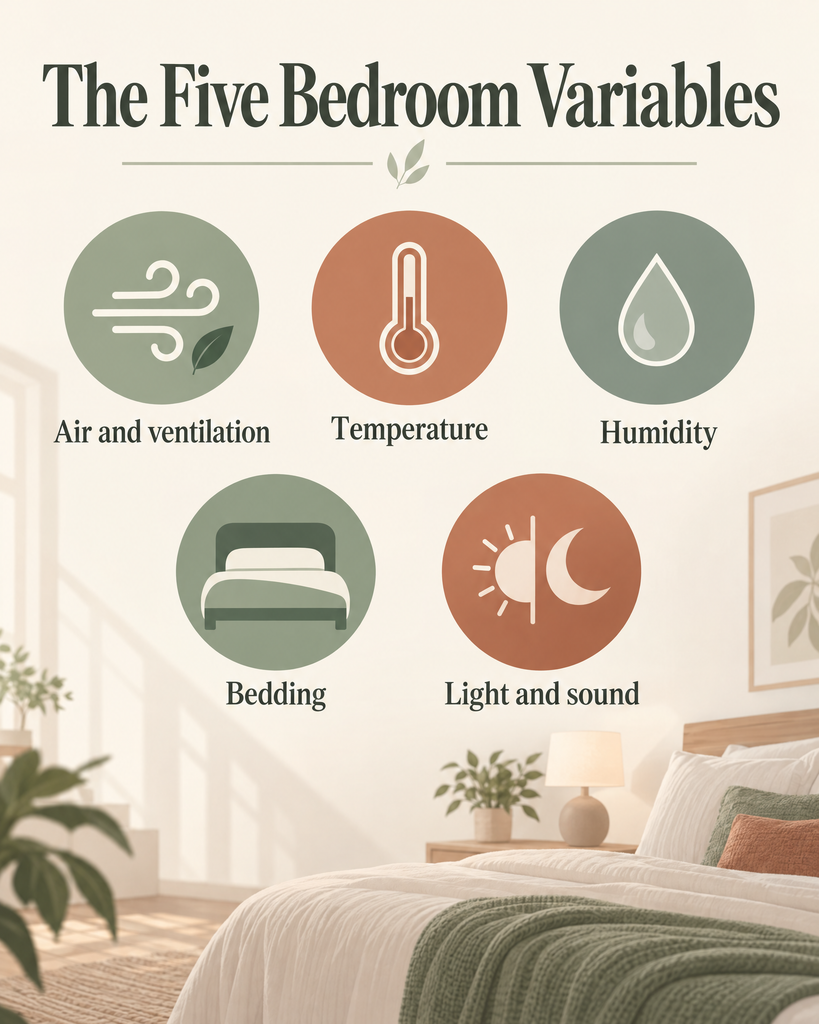
Air Quality and Ventilation. This is the most under-appreciated factor in the list. A study published in Indoor Air compared identical dormitory rooms over two weeks, with and without increased ventilation. With windows closed all night, CO2 averaged 2,395 ppm and ranged as high as 3,300. With a fan bringing in outdoor air whenever CO2 crossed 900 ppm, the average was 835 ppm. In the better-ventilated condition, students spent a greater percentage of their time in bed actually asleep and tended to perform better on next-morning concentration and attention tests. They also reported the air felt fresher and they felt more rested.
A closed-up rental bedroom with two or three people in it is exactly the condition the low-ventilation arm of that study was measuring.
Temperature. The lead researcher’s advice was blunt: if you want to fall asleep quickly, avoid overheating. A room that’s too warm is one of the most reliable ways to delay sleep onset, and vacation bedrooms are frequently set for daytime comfort rather than nighttime sleep.
Humidity. The EPA recommends 30% to 50% relative humidity in homes. On the Gulf Coast, a bedroom drifting well above that feels heavy and clammy, and it’s also the condition that invites the musty smell nobody wants to sleep in.
What’s in the bed. Eight hours of direct contact with bedding and a mattress makes this the highest-exposure surface in the house. Fragranced detergent residue on a pillowcase sits a few inches from your airway all night.
Light and sound. Unfamiliar streetlights, a different curtain gap, a new HVAC cycle, and the ocean — which some people find soothing and others find relentless.
| Typical Rental Bedroom | What Actually Helps | |
| Air | Closed up, AC recirculating | Fresh air before bed, purifier running |
| Temperature | Set for daytime comfort | Cooler at night, set before you get in |
| Bedding | Conventional, scented detergent | Organic bedding, fragrance-free wash |
| Scent | Plug-in or linen spray | Nothing added |
| Humidity | Unmanaged | Held in the 30–50% range |
| First night | A mystery you blame on yourself | Expected, and planned around |
1. Air the bedroom out before you get in it. Twenty minutes of cross-ventilation in the early evening, then close up and let the AC bring the temperature down. This is the single highest-return habit on the list and it costs nothing. On a humid coast, do it in a burst rather than leaving windows open all night.
2. Set the thermostat down well before bedtime. Rooms take time to lose heat, and a thermostat changed at 11 p.m. is working against you for the first hour of sleep. Avoid overheating is the one-line version.
3. Crack the bedroom door. If you can’t ventilate from outside, an open bedroom door meaningfully increases air exchange with the rest of the house overnight. It’s a small thing that addresses the CO2 problem directly.
4. Bring your own pillowcase. One item, no space, and it removes the most likely source of overnight fragrance exposure. If anyone in your group reacts to scented detergent, this is the first thing to pack.
5. Remove the scent sources from the bedroom. Plug-ins, linen sprays, reed diffusers, and candles. Take ten seconds on arrival and put them in a cupboard.
6. Plan the first night to be imperfect. Arrive earlier if you can, keep the first evening low-key, and don’t stack a 6 a.m. start on top of it. The first-night effect resolves by the second night — the trick is not compounding it with a short night on top.
7. Treat alcohol as a sleep variable, not a sleep aid. It shortens the time to fall asleep and costs you in the second half of the night. On a week-long trip that compounds quickly.
8. Keep a dark room genuinely dark. Check the curtain gap and the standby lights before you get into bed rather than at 2 a.m.
Ask what the bedding and mattresses are made of, and what the laundry is washed in.
Ask whether air purifiers are provided and whether any are in the bedrooms.
Ask whether bedroom windows open, and whether there are screens.
Ask how humidity is managed, particularly in a coastal property.
Ask whether anything scented is used in the bedrooms — linen spray and plug-ins are common and rarely mentioned in a listing.
Ask about blackout curtains if anyone in your group is light-sensitive.
Because part of your brain stays on watch. The Brown University research found one hemisphere remains more vigilant during deep sleep on night one, and the effect disappears by night two. It’s normal, and it’s temporary.
The Indoor Air study found that increased ventilation meant a greater proportion of time in bed spent asleep and better next-morning attention test performance, with CO2 dropping from an average of 2,395 ppm to 835 ppm. That’s a meaningful difference from opening up a room.
On a humid coast, generally no — you’d be importing moisture all night. Air the room out in a burst before bed, then close up and let the AC manage both temperature and humidity. If you have a cool dry night, an open window is a reasonable option.
Cooler than you’d set it during the day, and set early enough that the room has actually reached it. The research guidance is to avoid overheating, which is the error most people make rather than the reverse.
It can, by reducing particles in the room you breathe in for eight hours. It won’t replace ventilation — a purifier filters the air that’s there, it doesn’t bring in fresh air. Do both .
Better sleep on vacation isn’t about a perfect bedtime routine in a house you’ve been in for six hours. It’s about a handful of environmental variables that are easy to fix once you know they’re variables.
Air the room out. Cool it down early. Take the scent out. Bring your own pillowcase. And give the first night some grace, because your brain is going to do what it does regardless.
“The first night is biology. Every night after that is the room.”
Whether this is your first stay with us or your fifth, you’re welcome to ask what’s on the beds before you boo k.
Want to Actually Sleep on Your Next Trip? We’d love to host you.
Click this link to check availability and book direct.
Related: Indoor Air Quality on Vacation | How Air Purifiers Work | The Rooted Escape